
Active Warrants in Oklahoma County
An active warrant is a standing order to arrest. In Oklahoma County, the Sheriff's Office handles warrant enforcement through its Warrant Squad and Judicial Bureau, which works directly with the District Court and processes court orders. The Sheriff is Tommie Johnson III. The Sheriff's official page links the public warrant search along with the court-process, civil-process, and sheriff-sale units. The Court Process Division sits at 2101 N.E. 36th Street in Oklahoma City and can be reached at 405-713-1034.
The Sheriff's official page is the hub for warrant, court process, and civil process work. The image below shows that page.
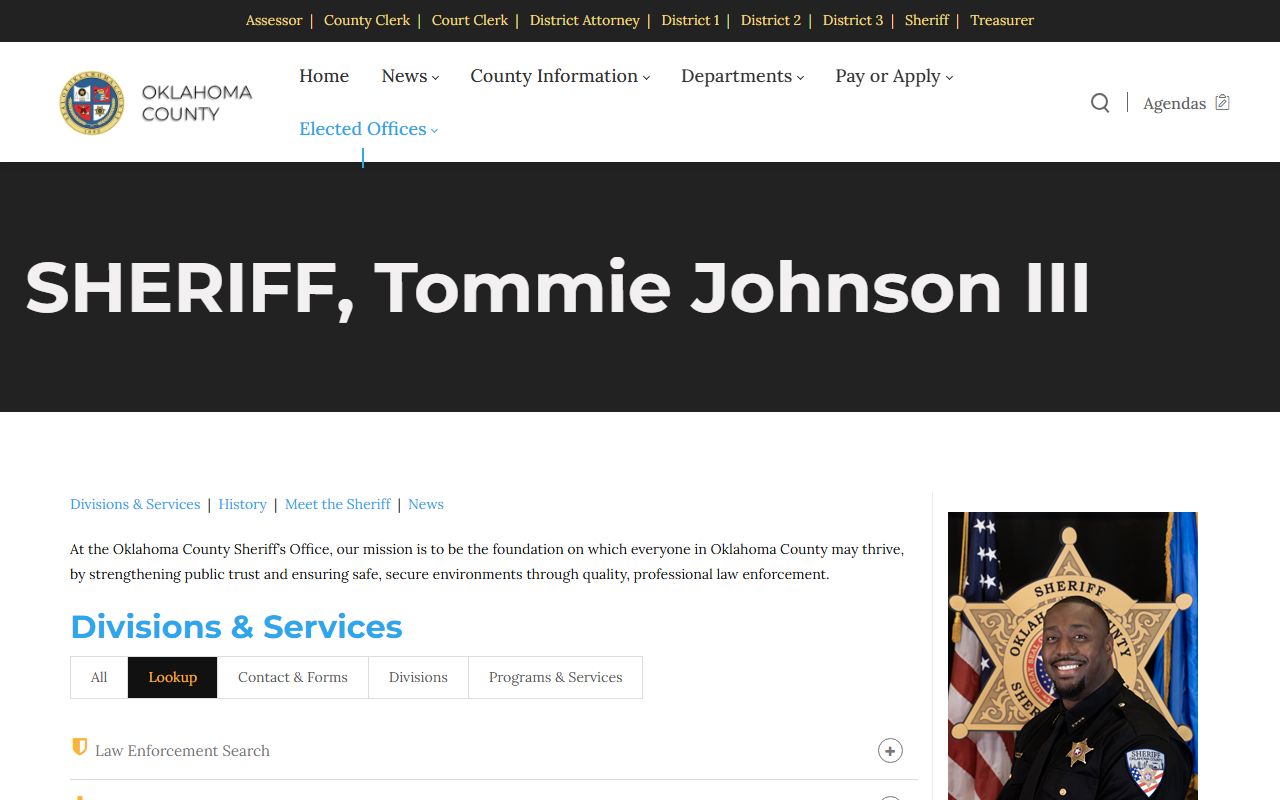
From here the public can reach the official Oklahoma County warrant search, which is the right starting point for any warrant lookup. Because a warrant ties back to a court case, the Sheriff page also points users to the court docket on OSCN to confirm the charge, the bond, and the hearing tied to the order. The Sheriff's Judicial Bureau combines the units that work directly with the District Court and enforce its orders, so the warrant search and the court docket are two halves of the same picture. The Sheriff's Office also runs civil process and sheriff sales, which are separate functions handled out of the Court Process Division rather than the courthouse filing counter.
Types of Warrants in Oklahoma County
Warrants come in several forms, and each one starts in a different way, but all carry the power to arrest. An arrest warrant follows a charge supported by cause. A bench warrant comes straight from a judge, often after a missed court date. A probation or revocation warrant follows a claim that someone broke supervision terms. The list below covers the main types you may see in an Oklahoma County warrant search.
- Arrest warrant - issued when there is cause to charge a crime.
- Bench warrant - issued by a judge, often for a missed court date.
- Failure-to-appear warrant - tied to a skipped hearing.
- Probation or revocation warrant - for a violation of supervision terms.
- Fugitive warrant - for a person wanted in another jurisdiction.
- Contempt or cost warrant - linked to unpaid court costs or a court order.
The type matters because it shapes how you resolve it. A failure-to-appear warrant may clear once you set a new court date, while a fresh arrest warrant on a felony charge needs counsel and a careful plan before you act. A contempt or cost warrant often points back to money owed on a case, which the Court Clerk can address through a payment plan. Knowing the type tells you which office to call first and what to bring when you go.
How to Search Oklahoma County Warrants
Start with the Sheriff's warrant page, then check the court docket for the case behind the warrant. Use both so you do not act on a result that is out of date. The Sheriff page is the official source, and the court docket on OSCN confirms the case details that a warrant listing may not fully show.
- Open the Sheriff's warrant search.
- Enter the last name and first name.
- Add a birth date or warrant number to narrow the list.
- Review the result and note the warrant or case number.
- Confirm with the court or the Warrant Squad before you act.
Cross-check the case on OSCN Docket Search to see the charge, the bond, and any hearing. If the names match but the details do not, slow down and verify, because two people can share a name and a birth date.
Oklahoma County Warrant Search Fields
The Sheriff's warrant search uses a small set of fields. Names work best, and a birth date helps tell apart people who share the same name. A warrant or case number, when you have it from the docket, returns the most exact result. The table lists the fields and how to use each one.
| Field Label | Type | Required | Notes / Format |
|---|---|---|---|
| Last Name | Text | Likely | The search target's surname. |
| First Name | Text | No | Narrows the list. |
| Middle Name | Text | No | Helps with common names. |
| Date of Birth | Date | No | Tells apart same-name people. |
| Warrant / Case Number | Text | No | Use when known from the docket. |
| Search / Reset | Button | n/a | Runs or clears the search. |
What an Oklahoma County Warrant Record Shows
A public warrant listing gives the basics of the order, linking a person to a charge and a court. The fields tell you who is named, why, and what bond the judge set if that is public. The table shows the fields you can expect from an Oklahoma County warrant record.
| Field | What It Shows |
|---|---|
| Name | The person named in the warrant. |
| Warrant Number | The ID for the order. |
| Case Number | The linked court case. |
| Charge | The offense or reason for the warrant. |
| Issuing Court | The court that signed the order. |
| Bond | The amount or type set, if public. |
| Status | Active, served, or recalled. |
Note: a warrant database can lag a quash or a recall, so a listed warrant should be verified with the court before anyone acts on it.
What to Do If You Have an Outstanding Warrant
Finding your own name on a warrant is stressful, so confirm the details first and stay calm. Check the bond amount and whether a court appearance is required. The charge behind the warrant is prosecuted by the Oklahoma County District Attorney, whose office page explains its role in the case.

Important: Do not assume a warrant is gone because you paid a fine. It stands until the court recalls or quashes it. Keep proof of any payment, bond, or new court date.
If you cannot afford a lawyer for a criminal charge, ask the court about the Public Defender. Appear voluntarily when advised, post bond where allowed, or ask the court for a hearing to recall or quash the warrant if that fits your case.
Reporting Tips and Victim Services
Tips about a wanted person go to law enforcement, not to a court. The Sheriff's Warrant Squad handles the arrest side of an active warrant. Victims of crime can get help from the District Attorney's Victim Witness Center, shown below, which guides victims through the case and explains their rights.
The Victim Witness Center supports victims from the charge through any sentence. Victims can also set up custody alerts through VINELink, which tells them when a person's custody status changes. That service is covered on the released inmates page.
Restricted Oklahoma County Warrant Records
Not every warrant is public. A sealed warrant may stay hidden until it is served, so a clear public search does not always mean there is no warrant. Grand jury and investigation material can also be closed. The public warrant search is also different from the Sheriff's law-enforcement portal, which is limited to authorized users only and is not open to the public. That separation means a clear result on the public page does not rule out a warrant that an officer could still see.
Because of these limits, treat a public result as a starting point, not the final word. When the stakes are high, confirm directly with the Sheriff or the issuing court, and review the case on court records to see the full docket behind the warrant.
Bond and the Court Case Behind a Warrant
Most warrants tie back to a court case, and that case sets the terms for any release. When a judge issues a warrant, the order often lists a bond amount and a bond type. Bond can be cash, surety through a bondsman, or a release on the person's own recognizance. The amount depends on the charge, the person's record, and whether the warrant came from a missed court date or a new offense. The docket on OSCN is the place to confirm the bond, the charge, and the next hearing.
Resolving a warrant usually means dealing with that underlying case, not just the warrant itself. Posting bond may lift the hold, but the case still moves forward to its next step. A bench warrant for a missed date may clear once a new date is set and the person appears. A warrant tied to unpaid court costs may require a payment plan through the Court Clerk. Because each path differs, confirm the details on the docket and, where a criminal charge is involved, talk with counsel before you act.