
The Oklahoma Open Records Act
Oklahoma public records are governed by the Open Records Act, found at 51 O.S. § 24A.1 and the sections that follow. The Act states a public policy that people have the inherent right to know about and be informed about their government. A record stays open unless a statute, a court rule, or a court order closes it. That presumption of openness is the starting point for any Oklahoma County public records request, and the office must point to a specific exemption if it wants to withhold a record.
The Act also defines its terms, which matters more than it sounds. The definitions at 51 O.S. § 24A.2 set what counts as a public body and a public record. That distinction sorts the records by custodian, because court records, county land records, sheriff records, and detention records each have a different holder and different rules. Sending a request to the wrong office is the most common reason a request stalls, so it pays to know the definitions first.
What Records the County Clerk Maintains
The Oklahoma County Clerk is the county recorder. The office keeps deeds, mortgages, UCC filings, plats, and county records. You can search recorded documents at the okcc.online land-records portal, and the office runs a recorder e-filing system for new filings. The County Clerk is the right office for property and county records, but it is not the office for court files. For a filed case, a docket, or a certified court document, the Court Clerk is the holder, not the County Clerk.
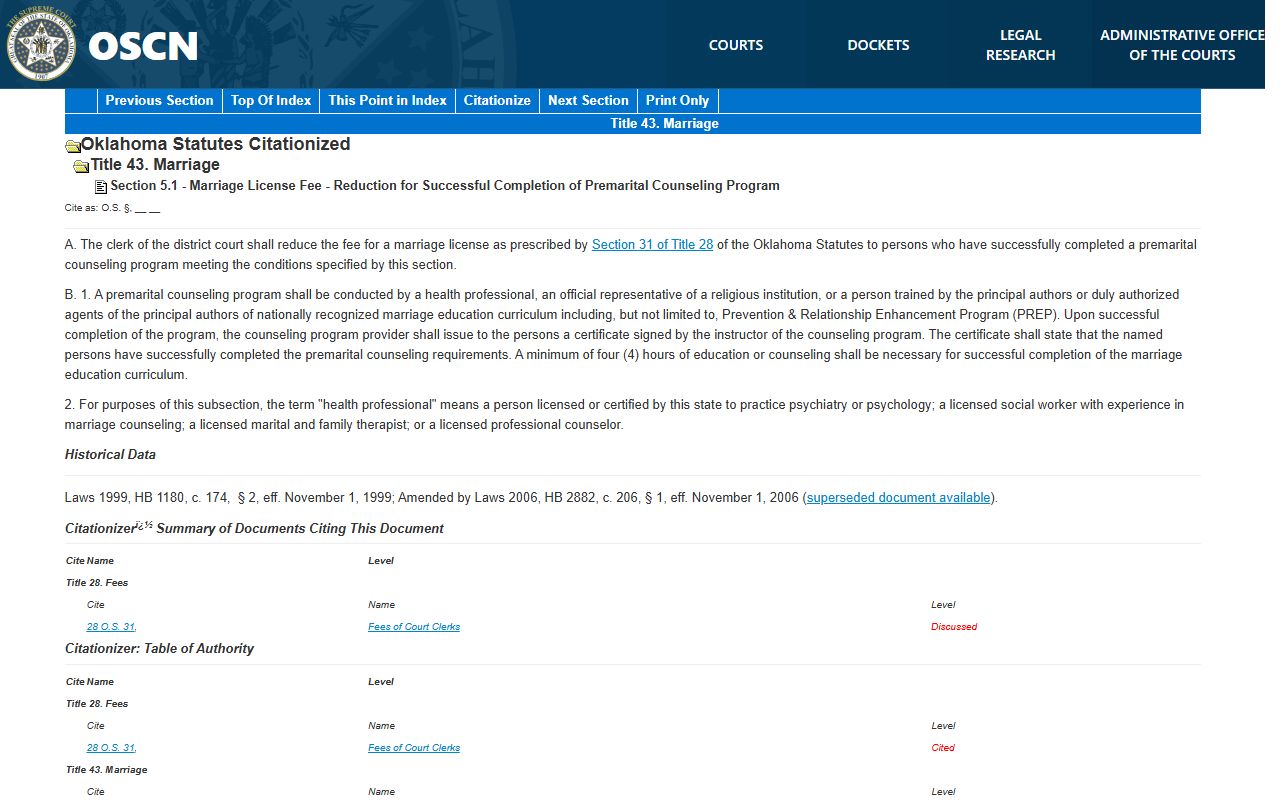
Marriage records sit with the Court Clerk and are shaped by state statute. The requirements come from 43 O.S. § 5.1, shown below, which sets the rules for age, consent, and the license itself.
After the ceremony, the license is returned and recorded under 43 O.S. § 7, shown below, which makes the record official and available for certified copies later.
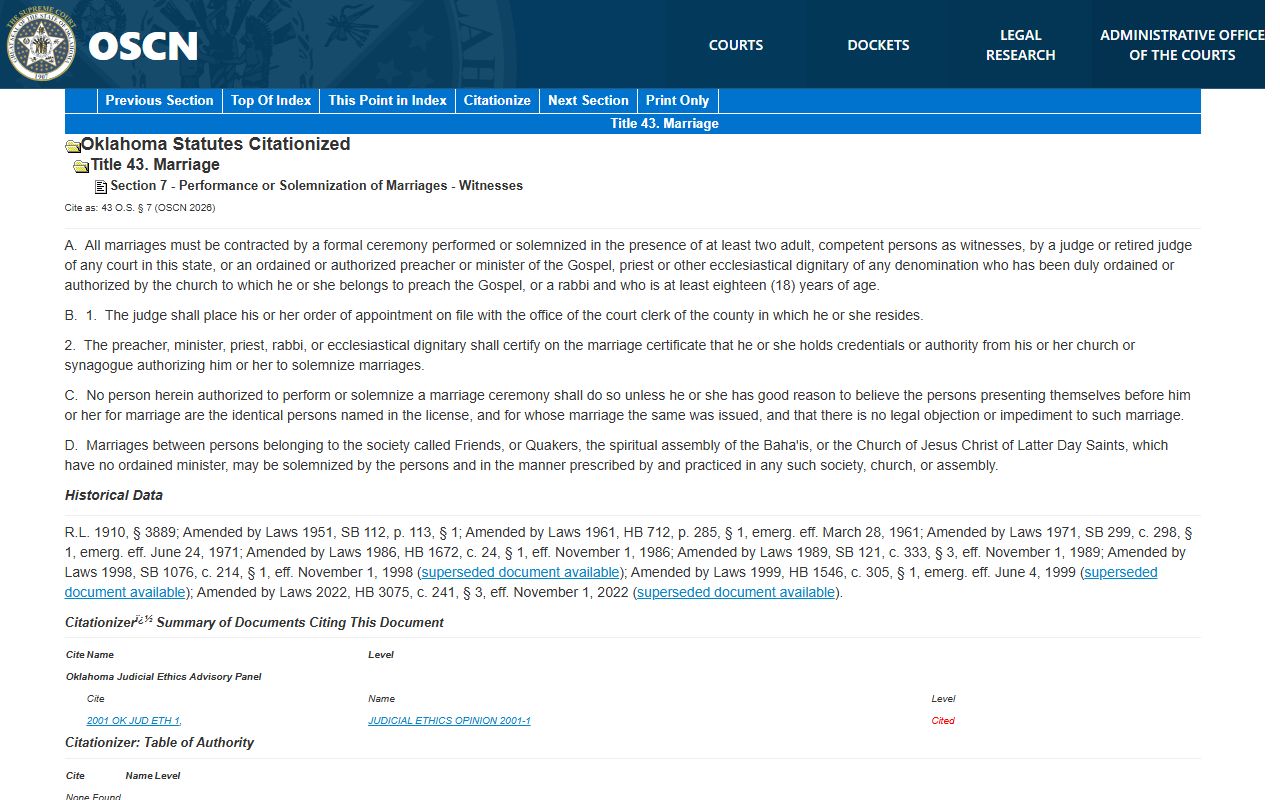
So the marriage record is a public record, but it lives with the Court Clerk, not the County Clerk. For the full process, fees, and certified copies, see the marriage and divorce records page.
How to File a Public Records Request in Oklahoma County
When a record is not already online, you can file a request with the office that holds it. The county runs an Open Records Request page for this purpose. Be clear and specific about what you want, because a tight request is filled faster than a broad one. Name the document, the people involved, and the dates if you know them.
- Find the office that holds the record.
- Describe the record with names, dates, or a case number.
- Submit the request through the county Open Records page or to the office.
- Give your contact details for follow-up and a cost estimate.
- Pay any allowed copy or search fee to receive the records.
For a court file or a certified copy, the Court Clerk handles the request, not the open-records office. For land records, the County Clerk is the holder. Sending the request to the correct custodian from the start saves the most time.
Public Records Request Form Fields
A request works best when it is specific, since vague requests draw follow-up questions and delay. The fields below cover what most requests need to move forward. The more of these you fill in, the sooner the office can find the record and give you a cost estimate.
| Field Label | Type | Required | Notes / Format |
|---|---|---|---|
| Records requested | Text | Yes | Describe the document, names, and dates. |
| Date range | Date | No | Narrows a broad search. |
| Office or department | Text | No | Name the holder if you know it. |
| Contact information | Text | Yes | Needed for follow-up and a fee estimate. |
| Format | Choice | No | Copy, certified copy, or inspection. |
Response Timelines
The Open Records Act calls for prompt, reasonable access. It does not set a fixed deadline in days. A simple request for one clear document may be filled quickly. A broad request, or one for older records, can take longer while staff locate and pull the files.
If a request is large, the office may need time to gather records and review them for exempt material before release. Staying specific helps the office respond sooner. You can also ask to inspect records in person rather than receive copies, which sometimes speeds things up and lowers the cost. If you do not hear back in a reasonable time, a polite follow-up that repeats the exact records you want, with names and dates, often moves a stalled request along faster than a broad complaint.
Public Records Fees in Oklahoma County
Offices can charge for copies and certain searches under 51 O.S. § 24A.5. The amount must reflect the direct cost of making the copy, and a search fee is allowed only in certain cases, such as a request made for a commercial purpose or one that would clearly disrupt the office. The table lists the common fee types you may see.
| Item | Amount |
|---|---|
| Copy of a record | Reasonable direct cost set by the office |
| Certified copy | Set by the holding office |
| Search fee | Allowed in certain cases under 24A.5 |
Ask for a fee estimate before a large request so the cost does not surprise you. If you only need to read a record and not keep a copy, inspection is often free, which is worth knowing before you pay for pages you do not need.
Records That Are Exempt
Not all records are open, and the Act and other statutes close several types. Law-enforcement investigation files have limits under 51 O.S. Section 24A.7, which protects active investigation material. Personnel records are limited under 51 O.S. Section 24A.8, which keeps many private employee fields out of public view. Personal communications also have an exemption under 51 O.S. Section 24A.10.
Court rules close more. Juvenile, adoption, and mental-health records are confidential. Sealed and expunged cases drop from public view. Personal identifiers like Social Security and account numbers are redacted from public copies. These limits exist to protect privacy and active cases, not to block ordinary access, so most everyday records remain open.
If Your Request Is Denied
A denial is not the end of the road. The Open Records Act lets you challenge it. First, ask the office to state the reason and the statute it relies on, in writing if possible. Often a denial is really a misunderstanding about which office holds the record or how the request was worded, and a clearer request solves it.
If you still disagree, the Act allows enforcement through the courts, and a person who wins may recover certain costs. For a court file specifically, the access rules on the court records page apply alongside the Open Records Act, because court records also follow court rules and sealing orders.
Court Records vs. Agency Records
Public records in Oklahoma County fall into two broad groups, and the path to get them differs. Court records are made by the District Court and held by the Court Clerk. You search those on OSCN and request copies from the Court Clerk, and they follow court rules and sealing orders on top of the Open Records Act. Agency records are everything else a public body holds, such as sheriff administrative files, county department records, and detention-center documents. You get those through an Open Records Act request to the office that holds them.
The split matters because the same name can show up in more than one system. A person can have a court case on OSCN, a booking on the Sheriff's jail roster, and a state record with the Department of Corrections, each held by a different custodian. A land document tied to that same person sits with the County Clerk. Sorting out which office holds the record you want is the single most useful step before you file any request, and it is why the definitions in the Open Records Act matter so much.